National and State Registers of Historic Places
Results of Query:
County: Shawnee
Records: All Properties
Page 11 of 12 showing 10 records of 113 total,
starting on record 1014 | 5 | 6 | 7 | 8 | 9 | 10 | 11 | 12
Union Pacific Railroad Passenger Depot
 701 N Kansas Ave
Topeka (Shawnee County)
Listed in National Register Oct 1, 2002
Architect: Underwood, Gilbert Stanley
Area of Significance: rail-related
Architectural Style(s): Classical Revival
Thematic Nomination: Historic Railroad Resources of Kansas
Uniontown Cemetery
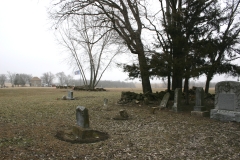 NW Douglas Road
Willard Vicinity (Shawnee County)
Listed in National Register May 17, 2010
Architect: N/A
Area of Significance: cemetery
Architectural Style(s): Other
Uniontown Cemetery is a significant physical landscape remnant of the short-lived community of Uniontown, a pre-Civil War settlement that served as a trading post, pay station, and ferry crossing along the Kansas River. It reflects, in part, an important period in the early history of the area when thousands of immigrants passed through the Potawatomi reserve on their way west. The settlement, a place where Native American and Euro-American cultures converged, thrived for a short period between 1848 and 1852 and is noted in the historical record as an important river crossing and supply stop. The cholera epidemic of 1849 and 1850, coupled with the success of other area river towns like Topeka, spelled the settlement's eventual demise. Although the settlement existed only a few years, the cemetery evolved into a rural family cemetery. Today, there are no extant buildings associated with the early settlement, and the exact location of the abandoned town site is not known. The small cemetery includes three separate marked burial areas each enclosed with a dry-laid native stone wall. Two of these enclosed areas are family plots dating primarily to the 1860s and 1870s. The third area is located in the center of the cemetery and is marked by a circular stone wall that marks a mass grave of Potawatomi from the cholera outbreak in 1849 and 1850. The cemetery was nominated for its association with the early settlement of Shawnee County.
United States Post Office & Court House
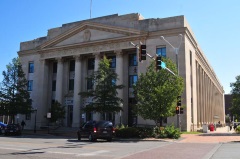 424 S Kansas Avenue
Topeka (Shawnee County)
Listed in National Register Mar 3, 2015
Architect: Wetmore, James
Area of Significance: post office
Architectural Style(s): Classical Revival
The United States Post Office and Court House in downtown Topeka is a Classical Revival-style building completed in 1933. It was nominated to the National Register of Historic Places for its significance in the area of architecture as a good example of the Classical Revival style applied to a multistory Federal building and in the area of law as the site of the 1951 district court case of Oliver Brown v. Topeka Board of Education. On August 3, 1951, in the building's court room, Judge Walker Huxman found that the Board of Education's segregation policies did not violate Plessy v. Ferguson as the plaintiff argued. The decision was appealed to the U.S. Supreme Court, which ruled on May 17, 1954 in favor of the plaintiff, thus making illegal racial segregation in the nation's public schools.
U.S. Post Office - North Topeka Station
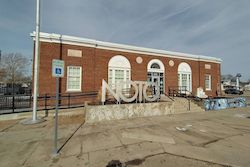 935 N. Kansas Ave.
Topeka (Shawnee County)
Listed in State Register Feb 6, 2023
Architect: J.D. Lovel
Area of Significance: post office
Architectural Style(s): Colonial Revival
The Post Office – North Topeka Station is a one-story, rectangular brick building in the Colonial Revival style. The building is important for its distinctive style and for retaining its character despite many hardships that devastated the area between its construction in 1920.
Wakarusa Hotel
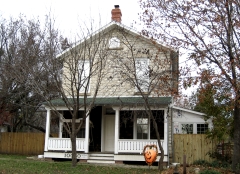 Main Street
Wakarusa (Shawnee County)
Listed in National Register Apr 4, 1979
Architect: Not listed
Area of Significance: hotel
Architectural Style(s): Other
Wakarusa Presbyterian Church
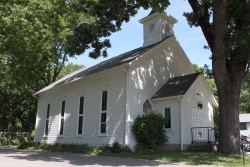 10135 SW Jordan Road
Wakarusa (Shawnee County)
Listed in State Register Nov 16, 2013
Architect: Unknown
Area of Significance: religious facility
Architectural Style(s): Vernacular
The Wakarusa Presbyterian Church is located in the unincorporated village of Wakarusa south of Topeka in southern Shawnee County. The town of less than a few hundred residents is situated along SW Jordan Road, a north-south thoroughfare that runs parallel to the former Atchison, Topeka & Santa Fe (ATSF) Railroad line. The small, wood-frame church is located at the south end of town within a grove of trees, just north of the Wakarusa River. It was built in 1878, several years after the town's founding, though within just a few years of the arrival of the ATSF railroad, which initiated a period of growth and development in and around the community. What remains of this small, unincorporated settlement was largely developed during the late 19th and early 20th centuries, coinciding with the growth of the railroad. Like other small towns in Kansas after World War II, Wakarusa's school closed and residents moved away, but the church congregation thrived. In addition to serving as a house of worship, the building has served other functions as a community center and polling place for the last half-century. It was nominated for its local significance in the areas of exploration/settlement and social history.
Ward-Meade House
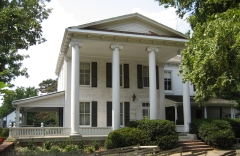 124 N Fillmore
Topeka (Shawnee County)
Listed in National Register Nov 12, 1975
Architect: Not listed
Area of Significance: single dwelling
Architectural Style(s): Classical Revival
Washburn University Carnegie Library Building
 1700 SW College Ave
Topeka (Shawnee County)
Listed in National Register Jun 25, 1987
Architect: Not listed
Area of Significance: library; college
Architectural Style(s): Classical Revival
Thematic Nomination: Carnegie Libraries of Kansas
Wea Creek Bowstring Arch Truss Bridge
 Grounds of the Kansas State Historical Society
6425 SW Sixth Avenue
Topeka (Shawnee County)
Listed in National Register May 9, 2003
Architect: Not listed
Area of Significance: road-related
Architectural Style(s): Bridge
Thematic Nomination: Metal Truss Bridges in Kansas
Westminster Presbyterian Church
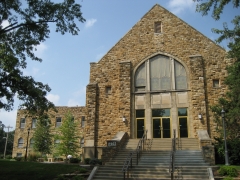 1275 Boswell Ave.
Topeka (Shawnee County)
Listed in National Register May 19, 2004
Architect: Not listed
Area of Significance: religious facility
Architectural Style(s): Late Gothic Revival; Late 19th and 20th Century Revivals
4 | 5 | 6 | 7 | 8 | 9 | 10 | 11 | 12

