National and State Registers of Historic Places
Results of Query:
County: Marion
Records: All Properties
Page 2 of 4 showing 10 records of 34 total,
starting on record 111 | 2 | 3 | 4
Elgin Hotel
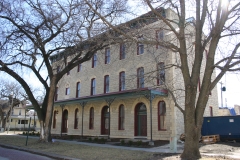 Third and Santa Fe Streets
Marion (Marion County)
Listed in National Register Sep 13, 1978
Architect: Not listed
Area of Significance: hotel
Architectural Style(s): Renaissance
First Presbyterian Church
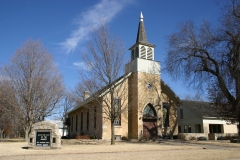 610 Lawrence
Marion (Marion County)
Listed in State Register Nov 17, 1978
Architect: Not listed
Area of Significance: religious facility
Architectural Style(s): Other
Florence Opera House
 SW Corner of 5th and Main
Florence (Marion County)
Listed in National Register Jan 18, 2011
Architect: John M. Anderson (builder)
Area of Significance: vacant/not in use; specialty store; music facility
Architectural Style(s): Italianate
Thematic Nomination: Historic Theaters and Opera Houses of Kansas
Built in 1883 and 1884, the Florence Opera House was the joint effort of French immigrants Gustave Caze, Emile Firmin, and Francis Ayral. Emporia contractor John M. Anderson built the opera house, which was noted in promotional material as having "imposing height and ornamental finish [that] give grace and dignity to the entire architecture of the town." The building was completed in just six months at a cost of $15,000. The first floor was designed for commercial use. The second floor was built to house both the opera house and offices, and the third floor was used as a stage and dressing rooms with a balcony at the back. The opening of the Florence Opera House on January 24, 1884 was touted as a "grateful triumph for the drama loving people" and "an important epoch in the history of Florence." The theater season began the following day, with a performance of the “Linwood Case,” a play written by Scott Marble. The opera house closed in 1917, by which time a movie theater had opened across the street. The building is significant for its association with local entertainment history.
Florence Water Tower
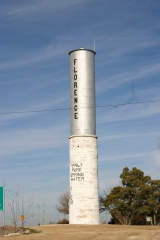 525 W 5th St. - E of US Hwy 77 at jct. US 50 & 77
Florence (Marion County)
Listed in National Register May 6, 2009
Architect: Johnson, C. O. (builder)
Area of Significance: water works
Architectural Style(s): Other
Fire destroyed four buildings in downtown Florence in the mid-1880s causing community leaders to consider developing a water works system for better fire protection. Under the direction of A. F. Horner, the Florence Water Supply Company hired local stonemason C. O. Johnson to build a water tower. The system originally took water from the Cottonwood River and included a pump house and well adjacent to the river in addition to the water tower across town on the hill. The pump house and well are no longer extant. The tower is a cylindrical structure measuring 110 feet tall and 18 feet wide. Its limestone base is covered with a layer of concrete, and the top half includes a metal storage tank. In 1920, new water and sewer lines were laid and arrangements made to have water brought into town from a spring north of Florence. The tower remains an integral part of the town's water system, which continues to take water from the spring north of town. It was nominated for its engineering significance and its association with the growth and development of Florence.
French Frank's Santa Fe Trail Segment
 Address Restricted
Lehigh vicinity (Marion County)
Listed in National Register Apr 3, 2013
Architect: N/A
Area of Significance: transportation
Thematic Nomination: Historic Resources of the Santa Fe Trail (Amended 2013)
French Frank's Santa Fe Trail Segment is located in Marion County, Kansas. The property was the location of a ranch established in 1861 by French immigrants Claude Francis (French Frank) Laloge and Peter Martin. Laloge and Martin most likely chose their location because of its proximity to other French-speaking settlers. The known list of provisions Laloge purchased and his previous experience as a cook at a station along the trail support the idea that French Frank's Ranch offered meals and small provisions to trail travelers. The ranch likely ceased operation in 1866 when trail traffic shifted away from this area of Marion County. Today, there are at least six visible swales that follow a northeast-southwest route that connected the Cottonwood Creek Crossing and the Little Arkansas River crossings along the main route of the Santa Fe Trail. In addition to the swales, the nominated property includes the "Cottonwood Holes" - a natural amenity noted in trail-era accounts, the site of a former trail-period ranch, and a 1907 commemorative marker erected by the Daughters of the American Revolution. It was nominated to the National Register of Historic Places for its significance in the areas of transportation, commerce, and social history, and it has the potential to yield additional important information related to trail ranches.
Harvey House
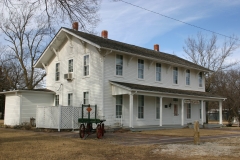 204 West Third
Florence (Marion County)
Listed in National Register Aug 14, 1973
Architect: Not listed
Area of Significance: hotel
Architectural Style(s): Other
Hill Grade School
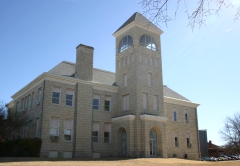 601 East Main
Marion (Marion County)
Listed in National Register May 28, 1976
Architect: Not listed
Area of Significance: school
Architectural Style(s): Renaissance
Island Field Ranch House
 US56/77 south of Lincolnville, Lincolnville vicinity
Lincolnville (Marion County)
Listed in National Register May 11, 1995
Architect: Not listed
Area of Significance: secondary structure; single dwelling
Architectural Style(s): Other
Keystone Ranch
 2910 47th Terr.
Burns vicinity (Marion County)
Listed in National Register Jul 10, 2017
Architect: Unknown
Area of Significance: Agricultural District
Architectural Style(s): Vernacular
Thematic Nomination: Historic Agriculture Related Resources of Kansas
Established in the early 1880s, Keystone Ranch is significant for its association with Marion County’s ranching history. From 1881 to 1902, German immigrant Frank A. Wells acquired 1,800 acres in the southeastern portion of the county where he established a sheep ranch. During his tenure, Wells constructed most of the extant structures at the ranch. After Wells’ death in 1913, the ranch was sold to T.J. Grace, whose family continues to own the entire 1,800 acres. Although the focus shifted from sheep to hogs, cattle, and horses, the ranch buildings continued to support the agricultural functions first established by Wells. Grace constructed a number of additional outbuildings, which were in place by 1960. Today Keystone Ranch is an excellent example of the evolution of ranching in this part of Kansas.
Lost Spring
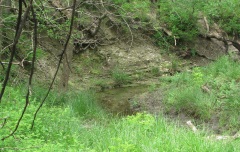 NE 1/4, SW1/4, Sec 16 & S1/2 Sec 17, Township 17 South, Range 4 East
Lost Springs (Marion County)
Listed in National Register Sep 30, 1976
Architect: N/A
Area of Significance: conservation area
The area around Lost Spring in Marion County was frequented by travelers along the Santa Fe Trail from 1821 to 1866. The presence of water (in the form of springs along both Lyon Creek and Cress Creek) and its location midway between Diamond Spring and Cottonwood Creek made this an ideal stopping point for travelers. The earliest travelers along the Santa Fe Trail stopped at the spring located along Lyon Creek. As the nature of trade and the types of travelers changed, a new route was created to bring travelers to the Lost Spring Station, located along Cress Creek, one mile to the west of Lyon Creek. It is unknown when Lyon Creek's association with the trail was forgotten, but certainly after the end of the trail's active years. The spring along Cress Creek received the full recognition as the Lost Spring of record, and it was listed in the National Register of Historic Places in 1976. The 1976 National Register nomination for Lost Spring includes a 10-acre site along Cress Creek. Recent research strongly suggests the Lost Spring frequented by early Santa Fe travelers is located a little over one mile to the northeast, within a 5-acre site in Section 16. In order to more completely document the history of the Lost Spring area, an amendment to the original nomination was produced in 2014 that expands the 1976 boundary to include the spring along Lyon Creek to create a 15-acre discontiguous site. A 1908 Old Settlers Lost Springs Station marker also is a part of this nomination.
- National Register Nomination (1976)
- National Register Nomination (2014)
- Inventory Record 1
- Inventory Record 2
1 | 2 | 3 | 4

