Kansas History - Forthcoming issue
Summer 2026
(Volume 49, Number 2)
“An Exceedingly Bright Girl”: Erma Bruce and the Color Line in Leavenworth
by Daniel Jantz
While many people assume that schools in Kansas were not desegregated until the Civil Rights Movement and the Supreme Court’s Decision in Brown v. Board of Education in 1954, the state’s history is much more complex. The “Black Exodus” brought an influx of Black Americans, which also brought increased economic growth that would spark conversations from white Kansans and lawmakers about segregating schools. Many Black Kansans in the late nineteenth century attended schools that were integrated. One of these students was Erma Bruce: an extraordinary young girl who was described as “brilliant” by both Black and white students at Leavenworth High School. Her success was so impressive, that in 1906, she was the front-runner for valedictorian of her class. A Black girl receiving recognition for her hard work and talent over her white classmates caused such a stir that she did not receive the honor. Bruce’s story sparked conversations about racial tensions in Kansas long before the modern Civil Rights Movement, and while integrated schools in Kansas existed much earlier than people realize, the reality of the time highlights a much less inclusive environment.
Cycling Together: Crossing Kansas by Bike in the 1970s
by Peter Simonson
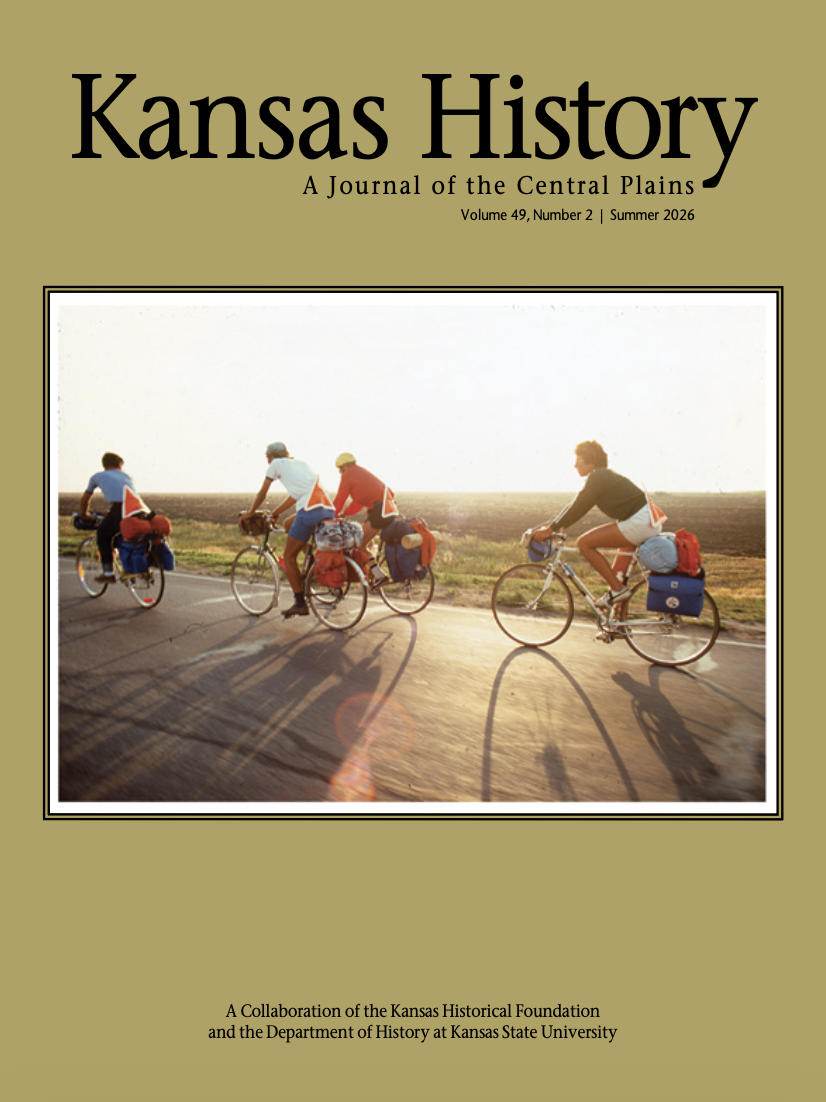
In the 1970s, as the U.S. experienced a crisis of confidence in government and other institutions, the bicycle served as an agent of renewal and collective joy. Adults reclaimed a pastime of their youth, and bicycles outsold cars for three years running. The "Bike Boom" played out in many ways, including the formation of local bike clubs and the growth of interest in long-distance cycling. Those came together in two events that made Kansas a center of cycling in the mid-1970s, one homegrown, the other international in scope. The first was Biking Across Kansas (BAK), a cross-state tour that began in 1975, organized by Kansans in local bike clubs. The second was Bikecentennial '76, a cross-country celebration of the nation's 200th anniversary that followed the newly created TransAmerica Trail, a 4,250-mile route bisecting Kansas on its way from Oregon to Virginia. Both events promoted cross-cultural contact between cyclists and locals, whose openness to the pedaling strangers earned the state the reputation of the friendliest and most generous along the TransAmerica. This article sketches the longer history of cycling in and across Kansas and the broader cultural contexts for the Bike Boom before turning to the mid-1970s, when riding across the state became a mass phenomenon that attracted thousands of ordinary people cycling together.
A Last Stand for Farm Fundamentalism: Interview with Jerry Stapleton on the American Agriculture Movement and 1979 Tractorcade
edited and introduced by Thomas D. Isern
In this article Jerry Stapleton, the adopted son of William “Dub” Anderson Stapleton Sr., shares his memory of his and his father’s involvement in farm activism and the American Agriculture Movement (AAM) in the late 1970s and early 1980s. This is the second interview in our tractorcades series, with the original interviews conducted by Kinsley librarians Joan Weaver and Rosetta Graff. Stapleton shares stories about his work with lawmakers, the protests and strikes he was involved in, and his efforts to create and establish conversations with other farmers surrounding agricultural economics. When Jimmy Carter and his administration pushed a farm bill that would only offer 90 percent parity, farmers got together to organize a strike and protest, which led to “tractorcades.” Stapleton was a self-described “constitutional conservative,” who continued his activism by supporting local conservative politicians to advocate for farming. While the AAM saw comparisons to the Populist movement, Stapelton argues here that the movement was more about conservative values to protect farmers from going into additional debt, what the article describes as “farm fundamentalism,” and minimizing government corruption to protect farmers. He also discusses his father’s involvement in the 1979 tractorcade, when dozens of farmers traveled across the country to Washington to protest the Farm Bill proposed by the Carter administration and Secretary of Agriculture Bob Bergland. Stapleton remained involved in politics and continued to advocate for farm fundamentalism throughout his life.
Book Reviews
Book Notes